 Back to Articles listing
How to become full stack developer
- March 27, 2025
- Read time unavailable
- By - MiT
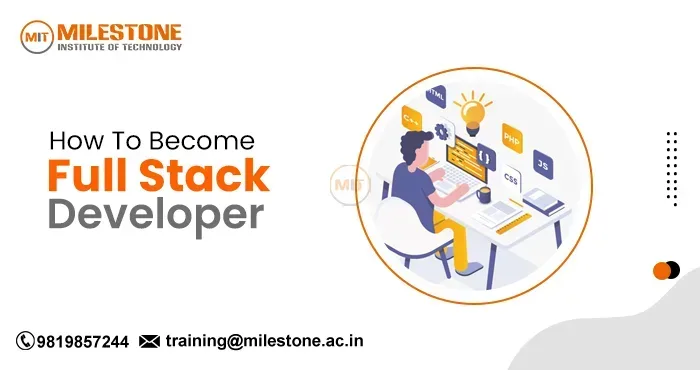
How to become full stack developer
The tech industry is booming, which in turn means that Full Stack Developer are in high demand. They are in high demand in companies., as such professionals can work on both front-end and back-end development. If your aim is to become a Full Stack Developer and pursue a career in web development, this guide can help you understand the journey of the same.What is Full Stack Developer?
A Full Stack Developer develops whole web applications and handles both the front-end and back-end of the job. They have experience with a variety of technologies, ensuring an integrated user experience.Key Responsibilities
One of the main tasks is to create user interfaces using HTML, CSS, JavaScript, and frameworks such as React or Angular. They also handle back-end capabilities with Node.js, Python, PHP, or Java with databases such as MySQL, MongoDB, or PostgreSQL. They also handle site responsiveness, performance, security, and APIs.Core Qualities a Full Stack Developer Must Have
Front-End Development Skills
HTML & CSS are foundational for building and styling web pages. JavaScript introduces interactivity, and front-end frameworks such as React.js, Angular, or Vue.js speed up development.Back-End Development Skills
You may also consider back-end programming languages like Python, Java, PHP, and Node.js power server-side coding. Database management requires knowledge of MySQL, PostgreSQL, MongoDB, etc., while RESTful, SOAP and GraphQL APIs help in the smooth exchange of data.Version Control & Deployment
The great way to keep the changes tracked and collaborate on them easily is to use Git & GitHub. CI/CD Pipelines help automate the activities of testing and deployment, and platforms such as AWS, Azure, or Google Cloud provide the ability to host the application.Additional Skills
Good debugging and problem-solving skills are a must. Mutual cooperation is critical, and soft skills (communication, cooperation, adaptability) improve collaborations. It will also help if you understand DevOps concepts like server management and security.What You Need to Know to Become a Full Stack Developer
Front-End and Back-End Technologies Selection
Once you feel comfortable with HTML, CSS and JS, choose a front-end framework like React.js or Angular.js plus a back-end language e.g., Node.js, Python, or PHP specialization.Build Practical Projects
These practical skills will help you to build real-world projects like a personal portfolio website, a CRUD (Create, Read, Update, Delete) application, an e-commerce site with authentication and payment integration, etc. Finally, to be a full-stack developer, one has to learn about version control and deployment. Deploying an application and collaborating requires knowledge of Git, GitHub, and cloud holding platforms such as AWS or Firebase.Get Started with a Full stack Development Course
Structured learning programs from Milestone Institute of Technology also provide practical training and mentoring, getting you industry-ready skills faster.Make a Solid Resume and Portfolio
Upload projects to GitHub to showcase your work. Write your learning journey on blogs like Medium and customize a resume for Full Stack Developer roles.Complete Job or Freelance Applications
Use job portals such as LinkedIn, Glassdoor, and Indeed to look for full-time work. For freelancers, Upwork and Fiver are the best options.Job Roles
Web Developer, Software Engineer, Front End Developer, Back End Developer, DevOps Engineer As a Full Stack Developer, you can explore the role of Every role specializes in a specific area, with user interface design, server-side performance optimization, etc.Conclusion
To become a Full Stack Developer, one must learn constantly and with hands-on experience. If you learn front-end, back-end, and database technologies you can have a great career in web development. Have no fear, the Milestone Institute of Technology offers some fantastic courses if you want to get industry-ready.Share this on
-

-

-

Recent Articles
-
What Should You Know Before Choosing CAD Design Jobs?
-
Top Civil CAD Courses for Engineering, Design & BIM Careers
-
Navisworks Course Training: Fees, Syllabus & Certification
-

Top CAD Interview Questions Freshers Must Prepare for Jobs
Archive posts
-
October2026
-
September2026
-
August2026
-
July2026
-
June2026
-
May2026
-
April2026
-
March2026
-
February2026
-
January2026
-
December2025
-
November2025
-
October2025
-
September2025
-
August2025
-
July2025
-
June2025
-
May2025
-
April2025
-
March2025
-
January2025
-
September2024
-
August2024
-
July2024
-
June2024
-
May2024
-
April2024
-
March2024
-
February2024
-
January2024
-
September2023
-
December2022
-
September2022
