 Back to Articles listing
Industrial Automation Course: Step Into High-Demand Roles
- November 22, 2025
- Read time unavailable
- By - MiT
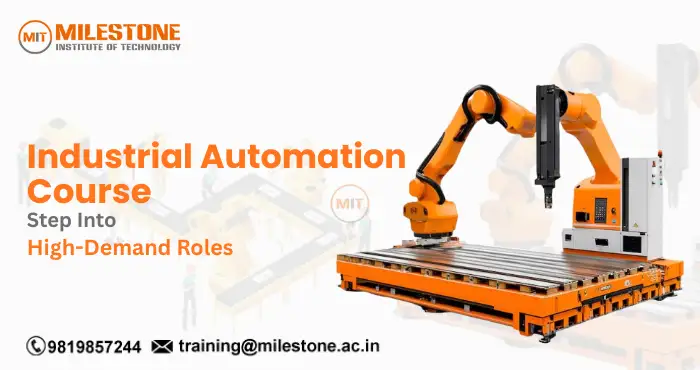
Modern industries increasingly depend on industrial automation to enhance performance, reduce manual labor, and maintain the quality of the end products. Automation technology accelerates production, increases accuracy, and allows for efficient operations in various industries including manufacturing, automotive, energy, pharmaceuticals, and packaging. As industries continue to evolve, having professionals with good automation skills standards will become increasingly essential.
Industrial Automation Course is one of the best technical career training programs for students and working professionals who want to build a stable and future-ready career.Understanding the Industrial Automation Course
An Industrial Automation Course is a formal training course that covers the basic principles of design, operation, programming, and maintenance of automation systems in industry. The course covers concepts to develop knowledge of the basic principles understand the operation of automation tools, equipment, controllers, and software that control modern industrial processes.
The primary goal of an Industrial Automation Course is to provide skilled professionals who can competently work with technologies such as Programmable Logic Controllers (PLCs) Human-Machine Interfaces (HMIs) Supervisory Control and Data Acquisition (SCADA) systems Variable Frequency Drives (VFDs) sensors instrumentation and industrial robotics. These skills are much in demand as industries rely on accurate and continuous processes to ensure product quality and production efficiency.Why Industrial Automation is Important in Modern Industries
Industries today are advancing towards smart manufacturing, or digital transformation. Automated systems complete tasks swiftly with great accuracy, which not only reduces operational error but also reduce production costs. Because of this, automation is an important factor for success in industry.
Industrial Automation Course graduates can enhance workflow efficiency, ensuring safety, dealing with sophisticated equipment, and contributing to production environments at scale. Automation also supports businesses to achieve global quality standards by providing repeatable production that minimizes the potential for human error.
In the automotive, electronics, food processing, oil and gas and logistics sectors, automation is critical not only to control processes, but to enhance monitoring and optimizing resource consumption. For these reasons, the need for trained experts in Industrial Automation Course continues to grow.

Key Skills You Gain from an Industrial Automation Course
A well-structured Industrial Automation Course offers an appropriate mix of theory and practical exposure. It aims to build a strong foundation of knowledge and hands on skills. Some of the major competencies you will acquire are:PLC Programming Expertise
Programmable Logic Controllers serve as the heart of many automated systems. In an Industrial Automation Course you will learn how to write logical programs manage input and output devices utilize timers and counters and do diagnostics on PLC based systems. This is one of the most valuable skill sets in the automation field.Proficiency in HMI and SCADA Systems
Human Machine Interface and Supervisory Control and Data Acquisition systems allow operators to visualize and control processes in industry. An Industrial Automation Course will teach you to create operating screens set up alarms review trending data and live control of processes using an HMI or SCADA system.Introduction to Industrial Robotics
An Industrial Automation Course provides you with hands-on information on sensors actuators motors variable frequency drives and instruments which function to control and measure industrial processes. You understand how the components integrate back into the overall system how to recognize the error and how to verify the operation is functioning smoothly.Introduction to Industrial Robotics
Companies are using robotic automation to improve their production efficiency. An Industrial Automation Course will help you learn the basics of programming robot movements, safely controlling movement, and basic robot operations. A strong understanding of robotic programming is a benefit in higher level automation roles.Pneumatic and Hydraulic System Knowledge
Pneumatics and hydraulics systems are used to control mechanical movement of parts in machines. An Industrial Automation Course will teach you the principles of pressure based systems and how they are used in various types of industrial machines and applications.Career Opportunities After Completing an Industrial Automation Course
A significant strength of an Industrial Automation Course is the range of different career options available. Industries around the world seek qualified automation technicians engineers and programmers able to efficiently control automated processes.
Some of the major career roles:Automation Engineer
An automation engineer creates implements and optimizes automated systems. Companies favor candidates who have taken an Industrial Automation Course because students learn programming tools systems integration and process control.PLC Programmer
This position entails writing logic programs that manage machines and processes. Due to industries’ increasing reliance on PLC based systems the need for PLC programmers is high.SCADA Operator
SCADA operators monitor manufacturing processes manage system data and stability of production processes. An Industrial Automation Course trains students to support this important role in operations.Maintenance Engineer
Maintenance engineers are responsible for repairing upgrading and maintaining automated and semi-automated equipment the technical knowledge gained in a course will help to understand the faults and keep the machinery performing properlyControl System Technician
Control technicians are responsible for control panels, wiring, testing, and troubleshooting. The practical skills gained in a course prepare you with hands-on experience to support this job.Industrial Robotics Technician
As industries integrating robotic solutions, there is a growing requirement for technicians with an understanding of programming and handling a robot.Why Choose an Industrial Automation Course for Career Growth
Automation is growing in all areas of work and industries are quickly adjusting to using smart technologies to stay competitive. As a result, skilled automation workers are getting better job opportunities faster promotions and greater career security.
An Industrial Automation Course will give participants confidence when dealing with all types of automated systems and solid problem solving skills. Students who are heading toward a technical career or working professionals that want to promote their career will benefit from this training.Conclusion
Enrolling in an Industrial Automation Course is an essential step toward creating a successful future in the field of engineering and technology. This course provides learners with expert knowledge advanced practical skills and a broad understanding of modern industrial systems. As industries continue to move toward automation the demand for qualified professionals will increase significantly. By taking an Industrial Automation Course you will prepare for a workforce with high demand jobs for long term career success.Share this on
-

-

-

Recent Articles
-

EPLAN Panel Design: Learn Electrical Schematics with Ease
-

CATIA Surface Modeling: Design Complex 3D Shapes with Ease
-

What Should You Know Before Choosing CAD Design Jobs?
-

Top Civil CAD Courses for Engineering, Design & BIM Careers
Archive posts
-
October2026
-
September2026
-
August2026
-
July2026
-
June2026
-
May2026
-
April2026
-
March2026
-
February2026
-
January2026
-
December2025
-
November2025
-
October2025
-
September2025
-
August2025
-
July2025
-
June2025
-
May2025
-
April2025
-
March2025
-
January2025
-
September2024
-
August2024
-
July2024
-
June2024
-
May2024
-
April2024
-
March2024
-
February2024
-
January2024
-
September2023
-
December2022
-
September2022
