 Back to Articles listing
Structural Design Course in Thane: Software & Career Guide
- August 18, 2026
- 3 Min
- By - MiT
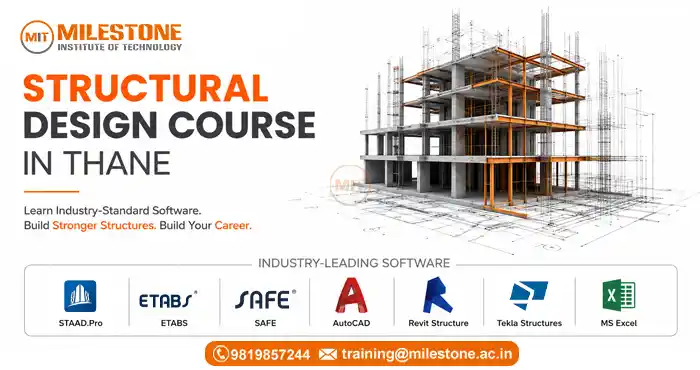
Structural Design Course in Thane: Software & Career Guide
Structural design is an important part part of civil engineering and construction. Every building requires a strong structural system that can absorb a variety of loads and stay stable over time. In the present time, structural engineers use specialized software for analysis, design, modelling, and detailing.
For civil engineering students and professionals, understanding these software tools and structural concepts is a way to develop practical skills. This is one reason why many students consider taking Structural Design Course in Thane to improve their technical knowledge and get ready for engineering careers.
A good course should be more than just software commands. It should include discussions about the structure, load considerations, how structural members are designed, and how software is used in real-world projects. Here’s what you can learn, software you should learn, the career outlook, and which training is best for you.What Is Structural Design?
Structural design refers to the planning and design of structural components of a building or other structure so that they can safely support the expected loads.
Structural engineers study the building requirements, select a structural system, calculate loads, evaluate the structure, and design its components.
Structural design requires knowledge of engineering principles, calculations, drawings, design standards, and software.Common structural elements include:
- Beams
- Columns
- Slabs
- Foundations
- Footings
- Shear walls
- Staircases
- Retaining walls
- Steel members
For students, please keep in mind that software does not substitute engineering knowledge. Software helps engineers perform calculations and analyses, but the engineer must know how to create the model and how to interpret the results.
This is why practical training is an important part of Structural Design Course in Thane.

Why Learn Structural Design?
Civil engineering has many career options, but structural design is one of the major areas for those who are interested in the construction, design, and construction of buildings and infrastructure.
Students learn many structural subjects in their engineering education. When it comes to applying a concept to a project, understanding it theoretically is not the same as applying it to the real world.
For example, a student may know the definition of bending moment, but may not know how to create a complete structural model, apply loads, analyze the structure, and interpret the results.
The structure design course in thane can fill this gap by combining engineering knowledge with software training.The main benefits include:
Practical Skills
This course will enable students to gain an understanding of how structural engineering concepts can be applied to real-world projects.Software Knowledge
Students will experience tools used in structural analysis, design, drafting, modelling, and detailing.Better Job Preparation
Practical skills can help students build a technical profile when applying for entry level positions in engineering.Project Experience
Students work on projects to learn how everything fits together rather than looking at each section individually.Career Development
The skills you acquire in structural design are transferable to a career in structural engineering, BIM, drafting, detailing, or related fields.
A Structural Design Course in Thane with practical projects can help learners understand how different structural concepts and software tools work together.

What Will You Learn in a Structural Design Course in Thane?
The syllabus of Structural Design Course in Thane should include structural engineering fundamentals and software-based practical training.Structural Engineering Fundamentals
Students should first understand the basic principles behind structural design.Important topics include:
- Types of structural systems
- Dead loads
- Live loads
- Wind loads
- Seismic considerations
- Load combinations
- Basic structural behavior
Structural Analysis
Structural analysis helps engineers understand how a structure responds to different loads.Students may learn about:
- Support reactions
- Bending moments
- Shear forces
- Axial forces
- Deflection
- Load combinations
RCC Design
Reinforced concrete is widely used in building construction. Students may learn the basic design process for structural elements such as:- Slabs
- Beams
- Columns
- Footings
- Staircases
- Shear walls
- Steel Design
Structural Detailing
After design, structural information needs to be communicated through drawings and details.
Students will learn the representations of structural elements on technical drawings and models, as well as detailing which supports construction and fabrication.Practical Projects
Project training is particularly helpful to beginners. By completing a project, the learner can see how the concepts and software tools work together.
A Structural Design Course in Thane with practical projects can help learners understand how different structural concepts and software tools work together.Structural Design Software You Should Learn
Software is an important part of modern structural engineering, but you do not need to know every tool. The software that is best for your job is important. Here are some of the common tools that you need to consider while deciding on a Structural Design Course in Thane.AutoCAD
AutoCAD is an extremely popular software for producing 2D technical drawings.
It can be used in structural work for plans, sections, layouts, structural details, and other forms of documentation.
An easy way to get started with AutoCAD is to learn how structures are represented in drawings.ETABS
ETABS is commonly used for building analysis and design.
The tool allows users to create models, define materials and sections, apply loads, perform analyses, and view results.
Students should learn the entire workflow, and not just software commands. They should also understand the model, loads, assumptions, and results.STAAD.Pro
STAAD.Pro is an analysis and design software for structural analyses of different kinds of structures.
Engineers can use this software to create a structure model, to add loads, to analyze the data and to conduct design checks.
It is suitable for students wanting to develop structural analysis and design skills.Revit Structure
Revit Structure is used to perform structural BIM and 3D modeling.
It enables professionals to build models of the structure, which include beams, columns, slabs, walls, and foundations.
Revit can be useful for learners interested in BIM, coordination, and modeling-based structure workflows.Tekla Structures
Tekla Structures is used for detailed structural modelling and detailing.
It is particularly relevant for professionals working with steel structures, fabrication, construction documents, and detailed structural models.
Learning Tekla could be useful for those wanting to study structural detailing or a career in BIM.
Choosing the right Structural Design Course in Thane can help you focus on the software that matches your intended career path.
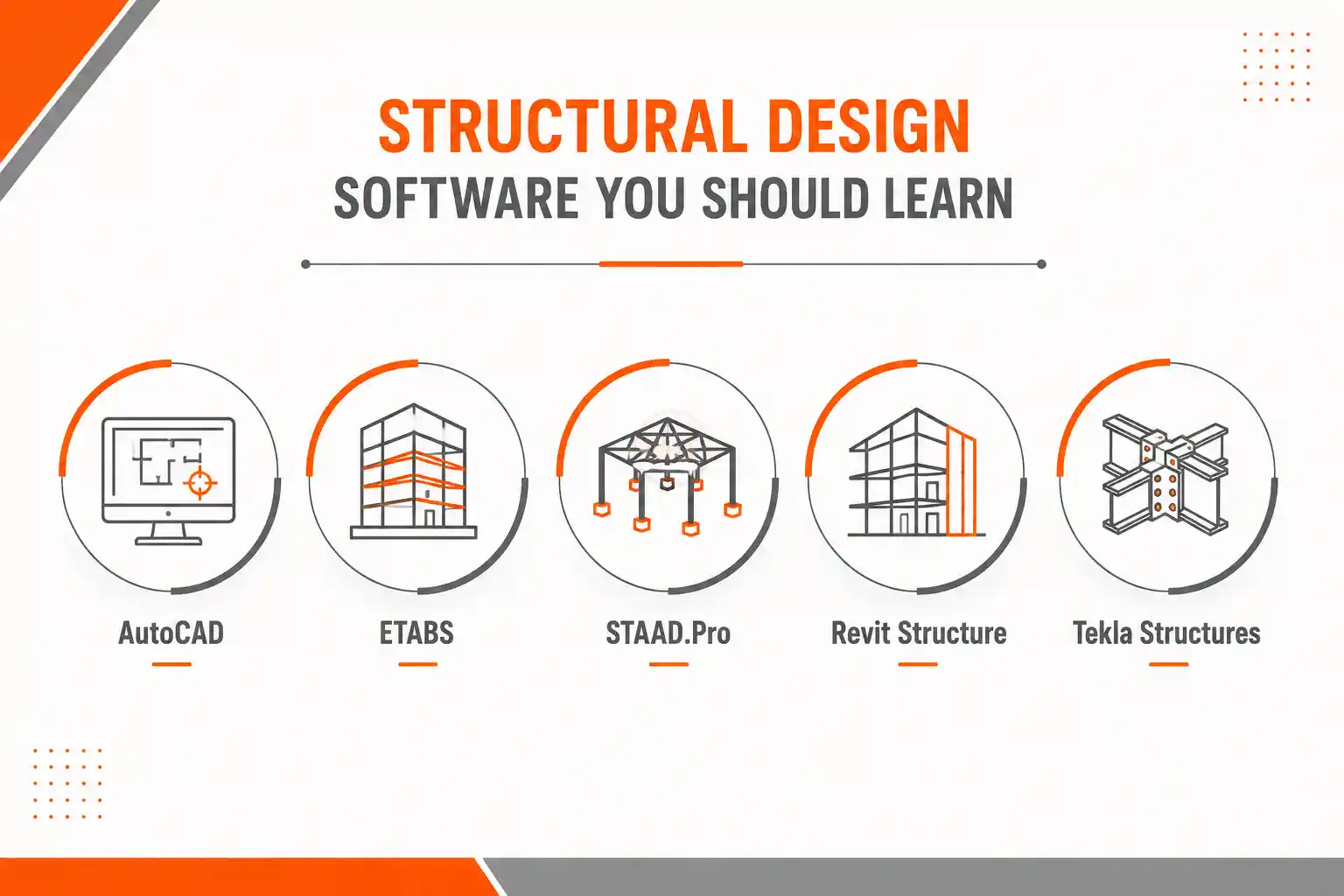
Structural Design Software at a Glance
| Software | Main Use |
| AutoCAD | 2D structural drawings |
| ETABS | Building analysis and design |
| STAAD.Pro | Structural analysis and design |
| Revit Structure | Structural BIM and modelling |
| Tekla Structures | Structural modelling and detailing |
The best software combination will depend on your intended career path. For a student studying structural analysis, ETABS and STAAD.Pro might be more applicable, while for a BIM student with an interest in detailing, Revit Structure and Tekla may be more relevant.
How Does Structural Design Work?
Understanding the full workflow makes structural design easier for beginning designers. A typical project could consist of these steps:1. Study Architectural Drawings
The structural team studies the architectural plans first to determine the layout, dimensions, levels, and requirements of the building.2. Structural Planning
The engineer chooses the structural system to be used and plans where major elements should be placed.3. Load Calculation
Depending on the project, different loads may be considered under various design standards.4. Structural Modelling
The structure can be made in appropriate software using beams, columns, slabs, walls, supports, materials, and other elements.5. Structural Analysis
The model is analyzed to understand how the structure behaves under different load conditions.6. Design
Structural members are checked and designed based on the results of analysis and requirements.7. Detailing
Design information is translated into clear structural drawings and details.8. Final Documentation
The drawings, models, calculations, and other project information are prepared for coordination and construction. Learning this complete process is one of the goals of practical training in structural design.Who Can Join a Structural Design Course in Thane?
A Structural Design Course in Thane can be beneficial to those with different backgrounds in civil engineering.Civil Engineering Students
Students can build practical software skills alongside their studies.Civil Engineering Graduates
Rather than starting their careers straight away, fresh graduates should use courses to expand their technical skills.Working Civil Engineers
Professionals can learn new software and improve their knowledge of structural design workflows.CAD Draftsmen
Professionals who have worked with technical drawings can learn detailing, modeling, and BIM software.Relevant Engineering Professionals
Professionals interested in learning more about structural design or BIM may wish to consider training based on their existing knowledge.Career Opportunities After Structural Design Course in Thane
Taking a Structural Design Course in Thane can help students prepare for different roles in the engineering and construction industry.Structural Design Engineer
Structure and design engineer is responsible for analysis and design of the structural integrity of buildings and structures.Junior Structural Engineer
Fresh graduates can start in junior positions and gain experience with a project.Structural BIM Engineer
A structural engineer works with digital structural models and coordinates project information with other disciplines.Structural Detailer
Structural detailers prepare detailed drawings and models used during construction and fabrication.CAD Engineer
CAD engineers work on technical drawings and documentation using computer aided design tools.Tekla Detailer
Trained professionals in Tekla may consider roles in structural modelling, detailing, and fabrication. Career opportunities depend on factors such as education, technical skills, practical experience, communication and employer requirements. Completing a course alone is not enough to guarantee a job.How to Choose the Right Structural Design Course in Thane?
Choosing the right training program is important because not all courses offer the same level of practical training. Before enroll in Structural Design Course in Thane, think about these points.Check the Syllabus
The course should cover structure concepts along with application software training.Look for Project Based Learning
The projects allow the students to put their knowledge to use and learn about the entire structural process.Check Software Coverage
Choose software based on your career goal, rather than choosing a course because it lists many tools.Consider Practical Training
Choose a format of learning in which you have plenty of time to practice and ask questions.Check Portfolio Opportunities
Project work can help students give examples of their skills they can refer to during the interviews.Look at Career Support
Resume preparation, interview guidance, placement assistance, and career counseling are helpful tools for students planning for employment.Focus on Skills
A certificate is valuable as proof of training, but it is more important to have practical knowledge, experience in project work, and the ability to properly use software to start a career.
When selecting a Structural Design Course in Thane, always give priority to practical skills and project based learning.Is Structural Design a Good Career Option?
Structural design is a promising career choice for civil engineers who enjoy design, calculation, problem solving, and technical work.
It can also take many different directions. Some are structural analysts or designers. Others focus on BIM, detailing, drafting, fabrication, or project coordination.
The key is to have a strong combination of engineering knowledge and practical skills.
Learning software without understanding structural concepts can be limited, and having a strong theoretical knowledge but no real-world experience in software may make it difficult to operate professional workflows.
The best approach is to develop both.
Engineering Knowledge + Software Skills + Practical Projects = Stronger Career Preparation.
Choosing the right Structural Design Course in Thane can be an important step toward developing the technical skills required for a career in structural engineering.Conclusion
Structural design is a field that involves engineering expertise, analysis, design, drawing, and modern software.
This Structural Design Course in Thane can help civil engineering students, fresh graduates, and working professionals to develop practical skills in structural analysis, design, modelling, and detailing.
Check the syllabus, software, practical projects, learning format and career support when you are choosing a course.
Choose training that helps you understand the reasons for what you see and how your professional software can help you understand the process.
With a combination of engineering fundamentals, software knowledge, and project experience, students have a strong base for careers in structural design, BIM, detailing, and other engineering positions.Frequently Asked Questions
1. What is a Structural Design Course in Thane?
It uses an active learning method to teach students about structure design concepts and software such as AutoCAD, ETABS, STAAD.Pro, Revit Structure, and Tekla.2. Who can join a Structural Design Course in Thane?
Students, graduates, professionals in civil engineering and CAD-related fields of work are welcome to apply.3. Which software is best for structural design?
ETABS and STAAD.Pro are commonly used for structural analysis and design, and Revit and Tekla are used for BIM and detailing.4. What jobs can I get after a Structural Design Course in Thane?
You can explore positions after a Structural Design Course in Thane such as Structural Design Engineer, Junior Structural Engineer, Structural BIM Engineer, CAD Engineer, or Structural Detailer.Share this on
-

-

-

Recent Articles
-

CATIA Surface Modeling: Design Complex 3D Shapes with Ease
-

What Should You Know Before Choosing CAD Design Jobs?
-

Top Civil CAD Courses for Engineering, Design & BIM Careers
-

Navisworks Course Training: Fees, Syllabus & Certification
Archive posts
-
October2026
-
September2026
-
August2026
-
July2026
-
June2026
-
May2026
-
April2026
-
March2026
-
February2026
-
January2026
-
December2025
-
November2025
-
October2025
-
September2025
-
August2025
-
July2025
-
June2025
-
May2025
-
April2025
-
March2025
-
January2025
-
September2024
-
August2024
-
July2024
-
June2024
-
May2024
-
April2024
-
March2024
-
February2024
-
January2024
-
September2023
-
December2022
-
September2022
